
• Skip to main content
Folkswitch: Folk Music One Step Beyond

Folkswitch: Folk Music One Step Beyond

Traditional folk meets new traditions

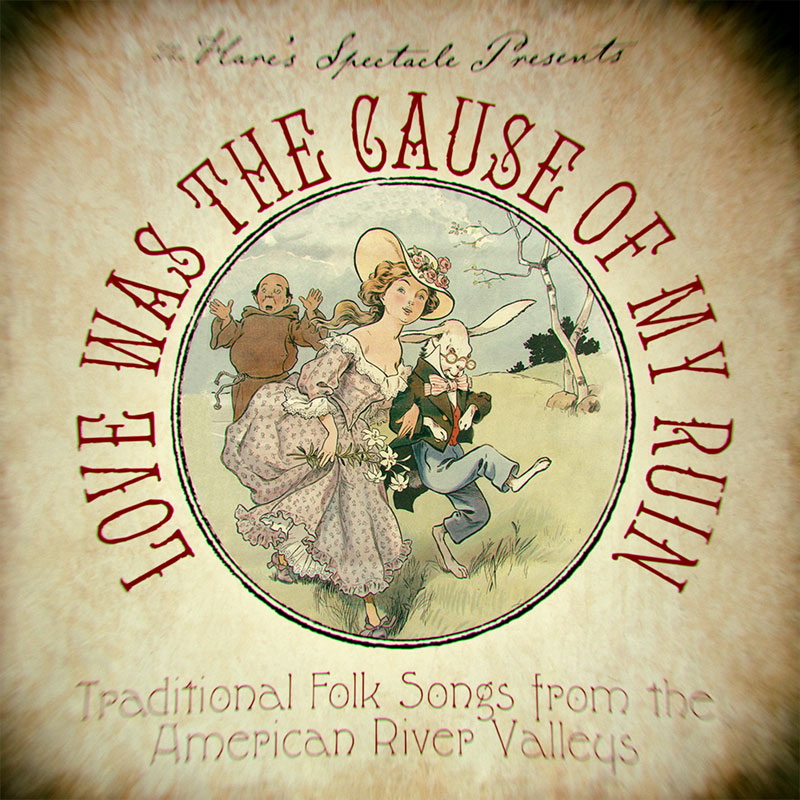
Love Was The Cause Of My Sorrow: Traditional Folk Songs From The American River Valleys


The rivers were the lifelines of the early part of the nineteenth century. Explorers followed them into new regions, towns sprung up, life sprung up. Where you have people you have music.

People sang the songs they brought with them. Quite often those songs were learned across the ocean. Even if you learned over here, you might have still learned it from your grandma.

The rivers brought new songs to the towns that sprung up along its banks. It didn’t take long for the popular songs of the day to make their way to the people. You could buy the latest broadsheets in a small town along the banks of the Little Wabash River in southern Illinois before mid-century.

A lot of these songs are tragic, involving heartache and woe - two popular subject then as now. Perhaps the difference between then and now is fewer people die in the course of song today.

It has been said by some this isn’t folk music, but that’s poppycock. There are countless folk singers and folk bands out there whose only connection to the folk tradition is that it’s played partly on acoustic instruments. That’s not folk. Folk music is music of the people, people making music for each other. On whatever instruments are popular in the day.

Is an Irish traditional tune any less traditional for being played on a fiddle, a more modern instrument than the harp it was originally written for? Why would a Stratocaster in the 21st century be any different then? After all, it’s been over fifty years since Fairport Convention played their first gig.

Folk traditions grow over time. To wish music stood still in a specific period is to wish for a golden age, and those exist in hindsight. Except for those who live it.

Folk music is music of amateurs, albeit at times, highly talented ones. They played for each other when music and songs was something you did, not just consumed.

The vocals could be a bit more ragged than more proper music. After all, a fellow in his cups is more inclined to sing, and sing loudly.

That’s the spirit behind this. These songs were being sung in American’s river valleys around the middle of the nineteenth century, in a variety of styles. We’ve added a few more and put them out there to see if they still echo here.

(Are You Going To) Scarborough Fair

OLD ENGLISH SONG SMASHED together with Dylan’s version. Not sure if Dylan actually wrote or compiled Girl of the North Country. Some things are just mysteries.

Todd Lane and I sang it George and Tammy style, one mike. I’m sure in his mind as well, we were wearing rhinestones and cowboy hats.

Scarborough Fair

Are you going to Scarborough Fair,
Parley, sage, rosemary and thyme,
Remember me to one who lives there,
She once was a true love of mine

Tell her to make me a cambric shirt,
Parley, sage, rosemary and thyme,
Without no seams nor needlework,
She once was a true love of mine

See for me if her hair hangs long,
Curls and flows, down her breast,
See for me if her hair hangs long,
That’s the way I remember her best

Sometimes I wonder if she remembers me at all,
Many times I’ve often prayed,
In the stillness of my night,
In the darkness of my days.

So if you’re going to Scarborough Fair,
Parley, sage, rosemary and thyme,
Remember me to one who lives there,
She once was a true love of mine

O’ Shenandoah

THE HISTORY OF THE OHIO RIVER VALLEY is of course, tied to rivers. Not just the Ohio, but a plethora of smaller rivers flow into it, bring with them the stories and songs of the regions the rivers meander through. The Ohio was the river that brought the songs to mass popularity.

Shenandoah’s lyrics come from fur trappers working the Missouri River, and often incorporate references to the Native American Chief of the same name. These fur trappers, as well as the flatboat pilots traveling down the Missouri brought the song to the Mississippi. It then made its way down that river to the ports on the Gulf of Mexico, and to the ocean going ships of the time. By the mid nineteenth century it was a sea shanty known throughout the world.

Fur trappers by necessity, had to get along with the Native American tribes, and it wasn’t unusual for them to marry from those same tribes. It’s often mistakenly thought that the river referred to is the Shenandoah River, but that lies mainly in Virginia, far away from the wide Missouri.

There is also more than a bit of the Negro spiritual in the melody, which is to be expected, as many slaves were forced to work the rivers, and used their songs as a form of shanty, to help keep the men working in unison.

We nicked the lyrics from Pete Seeger, who is known for another river altogether

Shenandoah
Traditional, United States, early nineteenth century

Oh Shenandoah, I long to hear you,
Look Away you rolling river,
Oh Shenandoah I long to hear you,
Away I’m bound away,
‘Cross the wide Missouri

Oh Shenandoah, I love your daughter,
Look away you rolling river,
Oh Shenandoah I love your daughter,
Look away I’m bound away,

‘Cross the wide Missouri
Oh Shenandoah, I’m bound to leave you,
Look away you rolling river,
Oh Shenandoah, I’m bound to leave you,
Away I’m bound away, ‘Cross the wide Missouri

Listen To The Mockingbird

THIS IS THE ONE SONG with a direct connection to Carmi, Illinois’ bicentennial. Which was the reason we were recording folk songs to begin with.  In the booklet for Carmi’s sesquicentennial, the author, J. Robert Smith referred to the song being sung in Carmi’s parlors, accompanied by the pump organ.

The music was written by a black street musician by the name of Richard Milburn. The lyrics were written by one Alice Hawthorne, which was a nom de plume for a fellow named Septimus Winner.

The song was written in 1855, and the sheet music for it went on to sell twenty million copies. Even Abraham Lincoln loved it. The lyricist however, didn’t love Lincoln, and also wrote a song urging Americans to vote for Gen. George McClellan, Lincoln’s opponent when he ran for re-election to the presidency.

This version kicks off with Fred Lowery’s performance in 1939, complete with bird calls. It’s part of the charm of the song that despite its tragic lyrics, it was given what can only be described as a spritely melody. Sometimes you have to laugh to keep from Crying

Listen to the Mockingbird

Lyrics by Alice Hawthorne, Music by Richard Milburn, United States, 1855

Last night I dreamed of my Halley,
Of my Halley, my sweet Halley,
Last night I dreamed of my Halley,
For the thought of her is one that never dies

She’s sleeping now in the valley,
In the valley, my sweet Halley,
She’s sleeping now in the valley,
And the Mockingbird is singing where she lies

Listen to the Mockingbird, listen to the Mockingbird,
Oh the Mockingbird is singing oe’er her grave,
Listen to the Mockingbird, listen to the Mockingbird,
Still singing where the yellow roses grow

How well do I yet remember,
I remember, I remember,
How well do I yet remember,
For the thought of her is one that never dies

It was in that sweet September,
In September, I remember,
It was in that sweet September,
That the Mockingbird was singing far and wide

Listen to the Mockingbird, listen to the Mockingbird,
Oh the Mocking bird still singing oe’er her grave,
Listen to the Mockingbird, listen to the Mockingbird,
Oh the Mockingbird still singing in the spring

  • « Go to Previous Page
  • Page 1
  • Page 2

Copyright © 2026 · Revolution Pro on Genesis Framework · WordPress · Log in